Tool Library or Bring-Your-Own: Two Ways to Equip a Workshop
Compare a workshop tool library with bring-your-own equipment to spot access gaps, prevent setup snags and choose the coordination your host can manage.
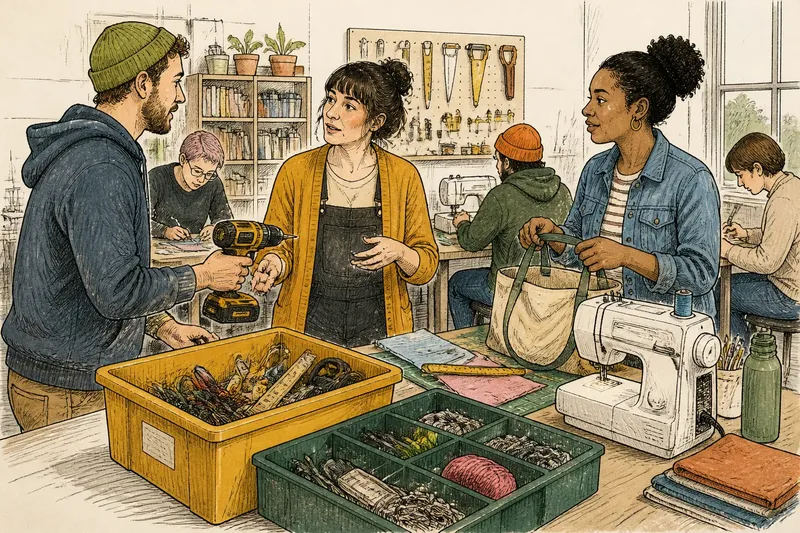
A workshop tool library solves the problem of who can bring a drill; bring-your-own solves it by asking each participant to arrive with suitable equipment. That choice affects access, setup and the host’s workload long before anyone starts making. A workable arrangement begins by spotting where each option tends to snag.
Start with the actual tools
“Bring tools” is too vague to be useful. One person may pack a cordless drill, another a hand screwdriver, and a third may assume the host has everything. A shared pool can be just as unclear if the list says “cutting tools” without naming scissors, craft knives or a handsaw.
Write down the tools needed for the planned activity, then mark which are essential, which can be shared and which participants may reasonably supply themselves. Include accessories that make a tool usable: drill bits, spare blades, clamps, extension leads or the correct charging cable. This is not a technical inventory for its own sake; it prevents a small missing item from stopping a table of people.
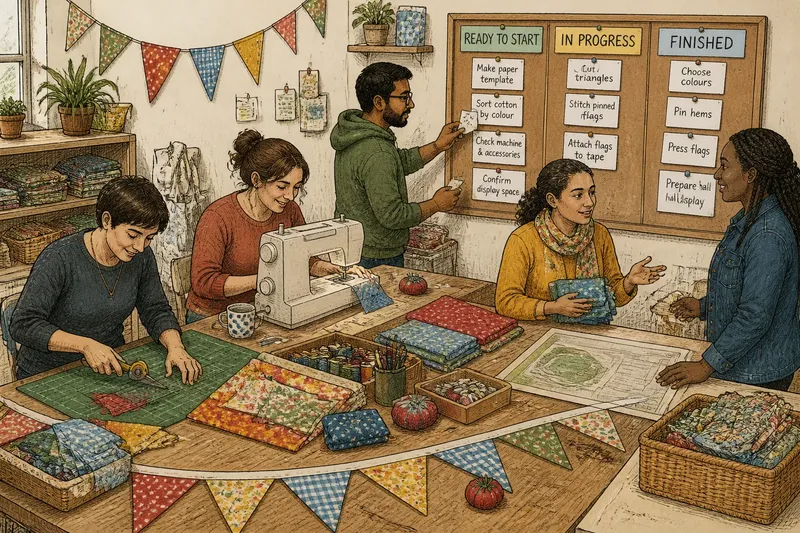
For a group making fabric banners, for instance, imagine the host lists fabric scissors, pins, rulers and sewing machines as separate needs. Participants can bring personal scissors if they have them, while the host arranges a few machines for shared use. The observable result should be a clear packing decision rather than several people arriving with machines and nobody bringing pins.
Write the tool name and quantity needed, not simply “bring equipment”.
Shared pool, missing tool
A library of shared tools makes participation easier for people who lack equipment, but it creates a handover problem: the host must know what is present, what is usable and where it will be found. A box marked “tools” can conceal a useful-looking collection with no scissors, no suitable bits or a pair of blunt shears.
Usually, the cause is a list built from memory or donations rather than the activity’s actual requirements. Before inviting people, compare the materials and tasks with the available pool. Set aside the items that must be shared, and name any gaps plainly. A borrowing request to a community centre or neighbouring group may fill a gap; if not, adapt the activity or ask participants to bring that item.
Make one host responsible for arranging the shared kit, and put it in a visible, labelled place before arrival. Keep the borrowing boundary simple: participants should know which tools are for everyone and which are being kept for a specific task. For powered or otherwise higher-risk equipment, follow the maker’s instructions and the venue’s rules; appoint someone competent to oversee its use.
Personal kit, uneven access
Bring-your-own can reduce the host’s storage and sorting, but it can quietly favour people who already own good equipment. It also leaves room for mismatches: a participant brings a small glue stick when the task calls for a hot-glue gun, or carries a screwdriver that does not fit the fasteners.
The usual cause is treating ownership as a neutral starting point. Offer a choice rather than a test of readiness: bring the named item if available, borrow from the host’s reserve, or tell the host in advance that you need one. Avoid asking people to buy a tool for a single session. If several participants need the same item, shifting that item into a shared pool may be simpler than arranging individual loans.
For personal equipment, ask for a short description or a photo only when compatibility matters. The aim is to catch a mismatch early, not to inspect everyone’s kit. If an item cannot be checked beforehand, provide a shared alternative where practical.
Setup gets crowded
Both arrangements can bottleneck at arrival. Shared tools need unpacking and placing; personal tools arrive in bags, sometimes in the middle of a busy room. If the first task depends on a tool that is still buried under coats, people wait while the host sorts the pile.
This usually happens because setup is treated as an informal prelude rather than part of the session. Decide who receives equipment, where it goes and how people will find it. A shared pool can be grouped by task on a clear table. For bring-your-own, designate a drop-off area and ask participants to keep their personal kit together until needed.
Keep the work surface clear enough for the first activity. If participants arrive at different times, give them a simple place to put equipment without interrupting the host’s welcome or preparation.
Returns become guesswork
Shared equipment can drift into bags, while borrowed personal tools may be hard to distinguish from the host’s. A missing item is often not lost at all; it has been set down at another table or packed with leftover materials. Without a return routine, the host discovers the confusion after people have left.
Choose a return point and mention it before work begins. For a shared pool, use a labelled tray or box and ask participants to return each tool there when finished. For personal kit, invite owners to collect their items from the designated area before the room is cleared. A quick visual check against the list can reveal what still needs attention without turning cleanup into a roll call.
If a tool is damaged, tell the host rather than quietly putting it back. The host can separate it from the usable kit and decide what to do next.
Which setup fits your workshop?
When is a tool library the better choice?
Choose a shared pool when access to equipment would otherwise prevent people from joining, or when the activity needs specialised items that few participants are likely to own. It suits a host who can prepare, label and oversee the kit.
When does bring-your-own work well?
It can work for familiar, portable items that many participants already have, such as pencils, fabric scraps or a basic tape measure. Name the exact item and provide a borrowing route for anyone who does not have it.
Can a workshop combine both approaches?
Yes. Keep essential or costly-to-share items in the host’s pool, while inviting participants to bring personal tools that are easy to identify and replace with a shared option. State the boundary clearly so nobody mistakes a request for a requirement.
What should the host decide first?
Start with the activity’s essential tools and ask who might be excluded if they had to supply them. That answer points towards a shared pool, a bring-your-own request with a reserve, or a mixture of the two.
Match the method to capacity
The better arrangement is the one the host can coordinate without making access depend on luck. A tool library asks for inventory, placement and returns; bring-your-own asks for precise communication and a plan for people who lack the requested item. Neither removes coordination. Each moves it to a different point in the session.
Before sending an invitation, compare the tool list with the host’s available time and storage. Then make the expectation unmistakable: what is supplied, what participants may bring, and whom to contact if they cannot. That small bit of clarity lets the workshop begin with making rather than a search through bags and boxes.
For a tool library or bring-your-own workshop, keep one final note beside the kit list: who will deal with missing, unsuitable or damaged equipment. Naming that person gives the group a calm route to a solution while the work is still under way.