Before the Makerspace: A Short History of Shared Workshops
Shared workshop history offers distinct models for learning, mutual support and access, helping local groups shape a space around what neighbours need.
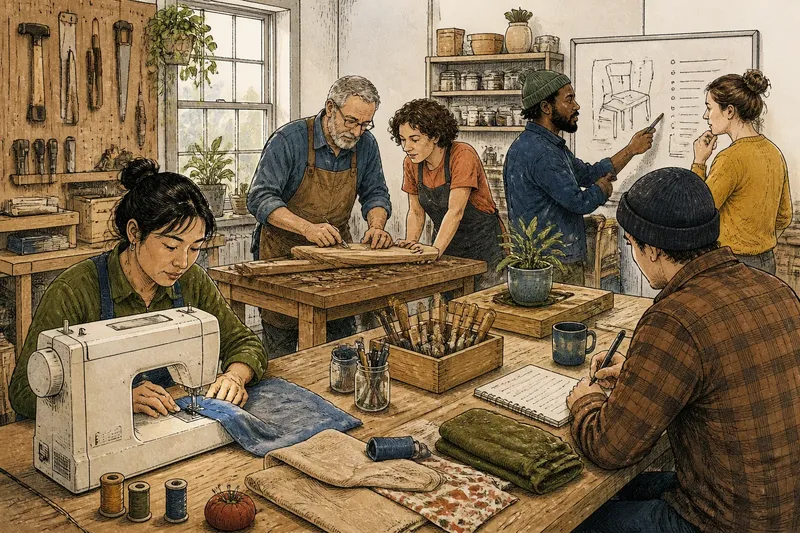
Shared workshop history is not a straight road from guild bench to makerspace. A room where people work side by side can serve a trade, answer a local need or teach a skill; those purposes are different, even when the tools look much the same.
That distinction matters when a community decides what kind of workshop to build. Rather than claiming one universal lineage, it is more useful to compare the recurring models and ask what each one makes possible.
Trade and apprenticeship
In a trade workshop, making and training were closely linked. A skilled craft worker could direct apprentices, oversee materials and assess whether an item met the standards expected in that line of work. The bench was both a place of production and a setting for learning through observation and practice.
This arrangement suited crafts that demanded sustained instruction. An apprentice might watch a joiner select and shape timber, then practise under guidance. Skills passed through close contact, but entry depended on the rules and customs of the particular trade. Such a workshop was not simply a public room with tools; it organised expertise and authority.
Trade groups could share standards and coordinate training, while their boundaries could keep outsiders away. The useful lesson for a present-day workshop is not to reproduce a hierarchy, but to make teaching and standards visible. A ceramics studio, for instance, can offer supervised introductions while leaving experienced members room to develop their own work.
Local work and reciprocity
Some shared workspaces grew from practical local needs rather than membership in a trade. Neighbours might pool labour, equipment or knowledge for work that was difficult to manage alone. Shared facilities such as a communal oven or local smithy could be part of everyday community life, though their exact arrangements varied from place to place.
In this model, cooperation is tied to use and responsibility. People contribute help or care for a shared resource, and the resource remains useful to those nearby. But informal customs can obscure who gets access and who is expected to maintain the space. Mutual aid does not automatically mean equal influence.
A neighbourhood repair bench could draw on this spirit: residents bring practical skills, share equipment and agree how the space is cared for. Put access and maintenance expectations in writing, so newcomers do not have to guess how the arrangement works.
Classes and public instruction
A class-led workshop puts teaching at the centre. An instructor can demonstrate a technique, introduce equipment and plan a project for learners with a range of experience. Participants may come to gain a useful skill or enjoy making, rather than to enter a trade.
This structure can make a workshop’s offer clear: learners know when a class meets and who is guiding it. It also has limits. A course follows a timetable and a planned subject, so people may have less room to pursue unrelated projects or use equipment outside sessions.
Imagine a neighbourhood room with a sewing machine and a volunteer tutor. The group chooses a weekly beginner class, prepares practice fabric and demonstrates safe machine handling; learners leave able to sew a straight seam, while people seeking open-ended project time still need a separate session. That is a clear trade-off: structure supports instruction, but does not replace flexible access.
Community studios today
A contemporary community studio may combine classes, open sessions, shared tools and collaborative projects. Its users can have quite different aims: one person wants to learn, another needs access to equipment, and someone else wants company while making.
That mix works best when organisers decide what the space is primarily for. A class-led room needs instructors and a schedule. A membership studio needs clear access arrangements and tool orientation. A project-based room needs ways for people to contribute without requiring everyone to make the same thing.
Consider a woodwork room. If most people need guidance, organisers might prioritise teaching sessions; if experienced makers mainly lack benches and tools, open access may matter more. If residents want to build something for a shared space, the group could set aside sessions for a joint project. The right format follows the recurring need, not the label on the door.
Choosing a workshop model
- Check whether people ask for instruction; if they do, organise a class or supervised session, and if they do not, prioritise another form of access.
- Check whether users already know how to operate the equipment; if they do, provide an orientation and suitable access, and if they do not, arrange teaching before independent use.
- Check whether requests centre on one shared local task; if they do, plan a project session, and if they do not, leave room for separate individual projects.
- Check who will clean, maintain and organise the room; if volunteers accept those duties, agree a rota, and if no one can take them on, reduce the offer or recruit support first.
- Check whether people can attend at the proposed times; if the schedule works for them, keep it, and if it does not, ask for workable alternatives before fixing sessions.
- Check whether newcomers can understand how to join and use the space; if the process is clear, share it plainly, and if it relies on personal introductions, make the rules easier to find.
Imagine a group with a sewing machine, practice fabric and a room available for evening sessions; these are invented planning details, not a report of an actual workshop. Members say they want to learn repairs, but no one volunteers to lead a standing class. The group asks a volunteer tutor to run a supervised introductory session, writes down how users book the machine and who tidies the room, then reviews whether people also want open project time. The resulting choice is a supported introduction first, rather than an unsupervised drop-in or a full course the group cannot staff.
Which model fits your group?
What distinguishes a trade workshop?
A trade workshop organises production and learning around a recognised craft, with expertise and standards at its centre. A modern group can borrow its attention to teaching without copying restrictive entry customs.
When does mutual aid suit a workshop?
It suits a group whose members share a practical need and can contribute to the resource’s upkeep. Make access and responsibilities explicit, rather than relying on unspoken local customs.
What is a class-led studio best for?
It works well for learners who want guided practice, a planned subject and support with unfamiliar tools. The trade-off is that independent use may be limited by the class schedule.
How can a group choose its format?
Compare the requests people make with the teaching, time and care the group can actually provide. Choose a manageable starting arrangement, then review it when local needs change.
History as a design aid
Shared workshop history offers distinct ways of organising work: trade training, local cooperation, planned instruction and broader community access. None is a universal blueprint. Each gives a different balance of expertise, flexibility and shared responsibility.
For a local group, the practical question is what people need to do together. A workshop built around classes needs someone to teach; a shared equipment room needs clear routines; a collaborative space needs room for different contributions.
Use shared workshop history to name the choices before settling on a format. Ask who the room serves, what support they need and who will care for it. Those answers can turn a collection of tools into a space people understand how to use.