A Shared Project Needs One Clear First Decision
A shared project starts better with one visible first outcome: use a paper sketch to agree what the group is making before tasks begin to multiply.
A shared project gets moving when everyone can point to the same first outcome. Before anyone divides up the work, agree what should exist at the end of the first session: a rough paper pattern, a labelled mock-up, or a small assembled section. That decision gives the group a shared starting point without pretending the whole project is already settled.
In a community workshop, this is useful because people arrive with different skills, expectations and amounts of time. One person may imagine a finished object; another may be thinking about a trial version. A small, visible outcome brings those assumptions into the open while there is still room to change course.
Choose a visible result
The first outcome should be something the group can inspect together, not a vague intention such as “make progress”. It might be a full-size paper outline for a noticeboard, a cardboard corner showing how a planter could fit together, or a drawn layout for a shared display. Keep it modest enough to reach in one sitting.
Visible does not mean polished. The point is to give people something concrete to discuss. A sketch can show that a proposed object is too wide for the available wall, that a handle needs more clearance, or that two people have imagined different arrangements. A conversation about marks on paper is often easier than a conversation about an unfinished plan in someone’s head.
Make the result specific in three ways:
- Name the object or part. “A paper outline of the shelf front” is clearer than “a design”.
- Say what it should help the group decide. For example, whether the shape suits the space.
- Agree what counts as done for now. A labelled sketch may be enough; a tidy drawing need not be.
Write that decision where everyone can see it. A sheet of scrap paper taped to the table can do the job.
Let the sketch ask questions
A paper sketch is a low-stakes way to begin because it is quick to alter and does not commit the group to cutting timber, sewing fabric or using shared equipment. It can be a plan view, a side view, a rough shape or several alternatives. Choose the form that makes the immediate uncertainty easiest to see.
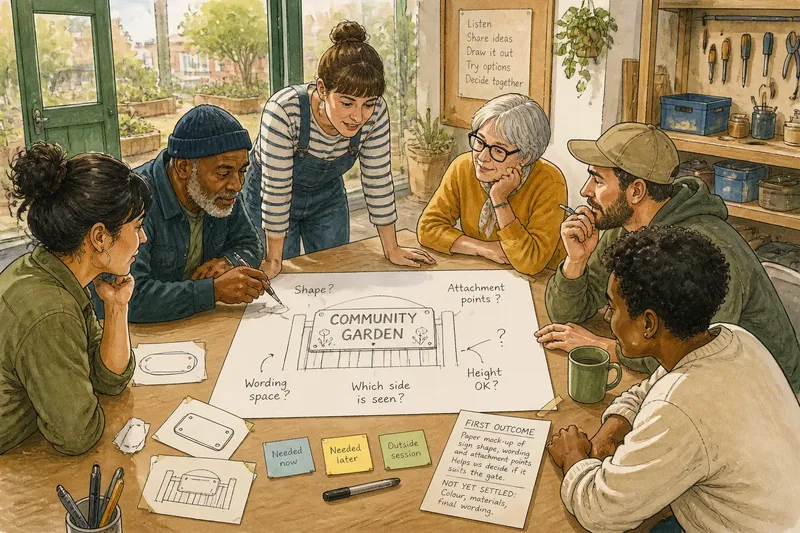
Say you are making a removable sign for a community garden gate. The group has agreed that the first outcome is a paper mock-up showing the sign’s shape, wording and attachment points. Someone draws a rectangle; another notices that the wording leaves no room for fixing holes. They shift the text and mark the holes on the page. The expected observable result is a sketch the group can inspect against the gate before choosing materials or dividing later work.
That is the useful work of the sketch: it makes questions visible. Is the object meant to be carried, hung or left in place? Which side will people see? What must fit around it? The answers need not be final, but the group should be able to tell which choices remain open.
Leave uncertain details visibly uncertain. Use a question mark beside a choice the group has not made, rather than drawing a confident line that could be mistaken for agreement. A sketch is a conversation surface, not a promise.
Agree what the first decision covers
Groups can lose time by trying to settle every detail before making anything. The first decision should be narrow enough to support action, but not so narrow that it hides a disagreement about the project itself. Agree on the first outcome and its purpose; leave later choices for later, provided they do not affect that outcome.
For instance, a group planning a set of shared storage labels may need to settle the label’s size and information before anyone prepares a full batch. It may not need to choose the final colour scheme at the same moment. The paper sample can expose whether the lettering is readable and whether the information fits, while colour remains an open choice.
It helps to distinguish among three kinds of decision:
- Needed now: a choice that changes the first visible result.
- Needed later: a choice that can wait until the group sees the result.
- Outside the first session: a question that belongs to a separate conversation, such as where a finished object will be stored.
Keep the list short. If the group uncovers a bigger question, note it rather than letting it swallow the first decision.
Keep the sketch open to everyone
One person can draw while others talk, but the page should not become that person’s private plan. Invite the group to point, annotate, move paper pieces or offer alternatives. If drawing feels like a barrier, use cut-out shapes, sticky notes or a few written labels. The shared decision matters more than anyone’s sketching skill.
Make room for quieter participants by pausing before treating silence as agreement. Ask what feels unclear, or invite people to mark a part of the sketch that needs another look. A person may be more comfortable indicating a problem on the page than interrupting a fast-moving discussion.
When the group settles the first outcome, record the decision in plain language beside the sketch. Include what the page represents and what it does not yet settle. That small note helps late arrivals understand the conversation and stops an early draft from being mistaken for a final specification.
What should the first outcome be?
Should it be a finished object?
Usually, the first outcome is more useful as a sample, mock-up or clearly bounded part than as a finished object. It should answer one practical question the group has agreed matters now, without demanding that every later choice be settled.
How detailed should the paper sketch be?
Include only the details needed to discuss the first decision, such as shape, position, labels or points of contact. Add a note where an important detail is still undecided so nobody reads a rough mark as a settled instruction.
What if the group cannot agree?
Ask which part of the disagreement the first outcome could make easier to discuss, then sketch two alternatives side by side. If the difference concerns a boundary the group cannot settle in the session, record it and agree who will bring the relevant information back.
When should tasks be divided?
Divide tasks after the group can describe the first outcome in the same way. At that point, people can volunteer for a specific contribution—such as drawing, checking the available space or gathering scrap card—rather than taking on vaguely defined pieces of a larger idea.
Move from agreement to action
Once the first outcome is clear, assign only the work needed to produce it. One person might draw while another measures the intended space, if that measurement is straightforward and appropriate; someone else can write down unresolved questions. Avoid assigning every future task at once. The group has agreed on a starting point, not designed an entire production schedule.
Before the session ends, put the sketch and its note somewhere the group can find them. Add the next question the result is meant to answer. At the next meeting, compare the paper outcome with the actual space, material or intended use, then decide what should follow. If the first result exposes a problem, changing the plan is progress, not failure.
A shared project’s first decision is valuable because it gives the group a common object to think with. Keep the paper sketch visible, keep its limits clear, and let the next decision grow from what everyone can now see.