The Group Project Myth: Everyone Does Not Need the Same Task
Group project fairness does not mean identical tasks. Match contributions to people’s time, preferences and strengths, while keeping the shared work visible.
Group project fairness does not mean handing everyone the same job. In a community sewing workshop, one person may cut fabric, another may welcome visitors, and a third may be able to join only for a short evening; the project can still be shared fairly if each contribution is visible and valued. The trouble begins when identical tasks are treated as the only honest measure of effort.
Imagine a neighbourhood group preparing reusable fabric bunting for a community hall. This is an invented situation, not a report of a real project. The group has a small planning team, a cupboard of donated cotton, a borrowed sewing machine and a deadline set by the hall’s open day. Its members have different schedules and different appetites for repetitive work. Their challenge is not to make everybody sew the same number of flags. It is to make a shared result without turning difference into resentment.
The Same-Task Trap
At the first gathering, someone proposes that each volunteer sew ten flags. The plan sounds tidy: everyone gets the same task, and the finished pile can be counted. But it quietly assumes that all members have the same access to a machine, the same confidence with a needle and the same free evenings.
One volunteer might own a machine and enjoy stitching long seams. Another may be skilled at careful cutting but cannot stay late. A third may be comfortable greeting people and sorting materials, yet anxious about sewing in front of a group. Assigning all three the same sewing quota makes the task look equal while making the chances of completing it uneven.
That mismatch can create a familiar chain of events. People who finish quickly take on extra work without discussion. People who struggle may stay quiet, miss a session or feel that their contribution counts less. The group then sees a pile of unfinished flags and an apparent effort problem, when the deeper issue was the way work was assigned.
Equal treatment is easy to describe, but a shared project needs a more useful question: what contribution can each person realistically make, and how will the group recognise it?
Map The Whole Job
The sewing team starts by laying out the work from donated cloth to finished bunting. They write down the tasks on scrap card: check and sort fabric, choose colours, make a paper template, cut triangles, pin hems, sew, press, attach flags to tape and prepare the hall display. They also note jobs that are easy to overlook, such as checking that the borrowed machine is returned clean and telling the hall contact when the bunting will arrive.
This map changes the conversation. Sewing is important, but it is not the whole project. Cutting accurately affects how easily the pieces join; sorting fabric prevents unsuitable scraps from reaching the machine; communication keeps the event plan from being a surprise. The group can now see contributions as connected work rather than as a contest over who handles the most visible tool.
They talk about three practical factors for each task:
- Preference: Which work does someone enjoy, or at least feel willing to do?
- Availability: Can the task be done during a meeting, at home or in a short drop-in visit?
- Capability: Does it require a skill or access to equipment the person has, or can the group provide support?
These questions are not a ranking of people. They help the group avoid assigning machine work to someone without machine access, or expecting a volunteer with a brief visit to complete a job that needs uninterrupted time.
Match Work To People
In this imagined group, Jo has a sewing machine at home and likes steady, repetitive stitching. Sam is careful with scissors and can attend only the first part of the workshop. Leila would rather talk with people than sew, and can help on the evening of the open day. Arun has limited free time between sessions but is happy to handle short messages and keep the task cards up to date.
The team matches work to those preferences without assigning permanent titles. Sam helps make a cardboard triangle template and cuts a batch of fabric before leaving. Jo takes a bundle of pinned flags home to stitch, with the machine’s borrowed status noted so the group can arrange its return. Arun keeps a simple task board and messages the group if a material or decision is missing. Leila checks the hall display area and welcomes visitors when the bunting is put up.
That division is not a claim that each task takes identical effort. It is a practical arrangement that lets different kinds of contribution move the same project forward. The group also leaves room for people to change roles: if Jo’s week becomes busy, the team can bring some sewing back to a shared session rather than treating an earlier offer as a binding promise.
Imagine that Sam finishes cutting sooner than expected, while Jo has more sewing than she can comfortably take home. The group can offer Sam a short pinning session with someone experienced, or ask another volunteer to take a small batch. The observable result they expect is a more manageable queue of flags, not a perfect division of minutes.
For a small team, write each task beside a name and a realistic time or place for doing it.
Make Contributions Visible
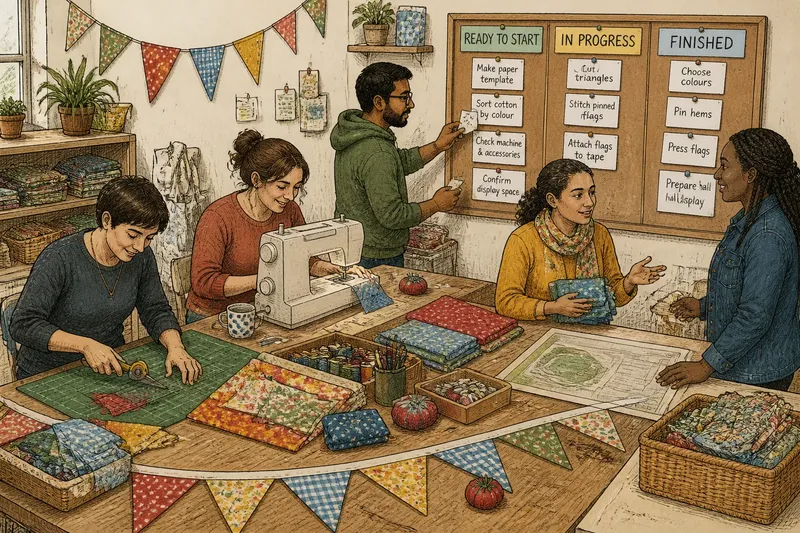
Different tasks can be hard to compare, especially when some happen out of sight. The group uses a noticeboard with three columns: “ready to start”, “in progress” and “finished”. A card for “sort cotton by colour” sits alongside “stitch pinned flags” and “confirm display space”. No one has to reveal private details about why they prefer one job or cannot take on another.
Visibility helps the team notice dependencies. If the paper template is unfinished, cutting cannot begin. If the flags are stitched but the tape is missing, the work is not ready for display. The board makes these connections clear without implying that the person whose card remains in progress has failed. Members can offer help, change the order or simplify the design while there is still time.
They agree to describe contributions concretely. “Leila is helping with the event” is less useful for coordination than “Leila will check the display area and greet visitors on the open day”. Specific descriptions make it easier to see what is covered and what remains, while leaving room for a person to decline a task that no longer suits.
A visible task board should record work, not score people.
Fairness Without Scorekeeping
Once tasks differ, someone may ask whether the sewing team is doing more than the people who cut cloth or manage messages. The group discusses fairness directly. They agree that no contribution needs to be identical in duration or difficulty, but that the work should not repeatedly fall on the same willing person simply because that person is dependable.
That distinction matters. A flexible division of work can become an excuse for one member to absorb every awkward or time-consuming job. To guard against it, the team checks who has been asked to take on extra work and whether anyone has been left with a task they dislike or cannot complete. They can then redistribute the remaining work, shrink the design or ask for another volunteer rather than quietly assuming that a familiar helper will cover the gap.
The team also treats preference as information, not a fixed identity. Someone who avoids sewing might be willing to learn a simple seam with support; someone who enjoys organising may not want to become the group’s permanent organiser. Asking again is better than assigning someone a role for good because it once worked.
When Should Roles Change?
What if nobody wants a particular task?
First ask whether the task can be made smaller, shared or removed without harming the project. If it remains necessary, invite volunteers to choose a manageable portion and agree on support, rather than quietly assigning it to the person who usually says yes.
How can a group include someone with little time?
Offer a clearly bounded contribution that can fit a short visit or be done remotely, such as checking a materials list or cutting a prepared batch. Make sure the task truly fits the time available and does not depend on a long chain of follow-up work.
Should everyone learn every skill?
Not necessarily. Shared learning can be rewarding, but a project does not need to turn every volunteer into a sewer, organiser and host. Give people a genuine choice between contributing through a familiar skill and trying something new with suitable help.
What if one person contributes much more?
Name the imbalance without turning the conversation into a judgement of character. Ask what work is still landing on that person, then reduce, share or reschedule it before the pattern becomes an expectation.
Finish As A Group
In the invented bunting project, the team reaches the open day with flags sewn, joined to tape and ready for the hall. The result is observable: the display can be hung, the borrowed machine is accounted for, and the people who helped can point to different pieces of work that made it possible. The group does not claim that everyone contributed the same amount. It can instead explain how the work was divided and where the arrangement needs changing next time.
After the event, they take a few minutes to ask which tasks suited people, which were harder to see and where work collected around one person. They keep the answers focused on the process, not on a tally of individual worth. That conversation gives the next shared project a better starting point without requiring the same roles or the same kind of object.
Group project fairness grows from matching work to real people, then checking that the arrangement remains workable. For a community project, the useful question is not whether every volunteer did the same task. It is whether the group made room for different contributions, noticed the work that would otherwise disappear and adjusted before a mismatch became a grievance.
When you plan your next shared project, make the work visible early and leave the assignments open to revision. A fair division is not a frozen promise; it is a way for people with different time, preferences and skills to keep making something together.